I BUILT AN AI SYSTEMTHAT KNOWSWHEN IT'Sallowed to act.
Multi-agent meeting intelligence with cross-agent validation, confidence-gated execution, human-in-the-loop approvals, and deterministic business actions.
basically... your meeting ends and the system figures out what the hell needs to happen next.
HOW THE SYSTEM DECIDES
Meeting ends(Zoom, Google Meet, etc.)
↓
≋Transcribe& structure
↓
▤Agent 1IntelligenceWhat happened?
☷Agent 2StrategicWhat should happen?
✉Agent 3CommunicationWhat to say & to whom?
↓
Cross-agent validation(confidence + conflicts)
↙↘
AUTO EXECUTE(invoice, contract, calendar, CRM, email)
HUMAN REVIEW(in operator panel)
basically... your meeting ends and the system figures out what the hell needs to happen next.
WHERE YOU CONTROL IT
THE CALL ENDS. NOW WHAT?
So instead of treating the meeting like a document to summarize, I treat it like unstructured business input that needs to become structured business state.
Most meeting tools stop at the transcript. But the transcript isn't the work. The work is figuring out what was agreed, who owns what, what needs to happen next, and whether the system actually has enough information to act.
Client: Yeah, so we'd like to move forward with the pro plan...
Client: Can you send the agreement this week?
Client: And let's schedule another call next month to review onboarding.
Client: I'll have my finance team handle the payment.
You: Perfect. I'll send that over.
Raw conversation (unstructured)
BECOMES
WHAT WAS SAID
Send contract
WHAT WAS AGREED
Pro plan
WHO OWNS IT
Finance team
WHAT HAPPENS NEXT
Schedule next call
WHAT'S STILL UNCLEAR
Payment timing
I WASN'T LETTING ONE AGENT RUN THE WHOLE THING.
So I split the reasoning.
AGENT 1
Intelligence
“What actually happened?”
Grounded extraction.
Pulls facts, commitments, entities, and intent
Uses only what's in the conversation
SYSTEM PROMPT (excerpt)Extract facts from the transcript. Do not infer. Return structured JSON with citations.

{ "entities": [...],
  "commitments": [...],
  "dates": [...] }
AGENT 2
Strategic
“What should happen next?”
Action planning.
Given those facts, what should happen next?
Flags risks and low confidence
SYSTEM PROMPT (excerpt)Given the extracted facts, create an executable plan. Be explicit about assumptions and missing information.

{ "actions": [...],
  "approvals": [...],
  "confidence": 0.72 }
AGENT 3
Communication
“What needs to be said, and to whom?”
Message generation.
What needs to be said, and to whom?
Uses the right context
SYSTEM PROMPT (excerpt)Write a professional email based on the plan. Use the facts provided. Do not add new claims.

{ "to": "customer",
  "subject": "...",
  "body": "..." }
Three different jobs. Three different responsibilities.
I wasn't about to let one model decide what happened, what it means, what we should do, what we should tell the customer... and then execute all of it. Nobody gets to quietly make the entire business decision alone.
that's a little too much unchecked confidence for my liking lmao.
HIGH CONFIDENCE STILL DOESN'T MEAN “GO.”
A model saying “I'm 92% confident” doesn't automatically mean I'm letting it touch the business.
Confidence is an input. It is not permission to execute.The AI can recommend an action. The control layer decides whether it's allowed to happen.
IF IT'S NOT SURE, IT LITERALLY STOPS.
This is where it gets fun. If validation catches something it doesn't trust, the workflow doesn't fail. It waits.
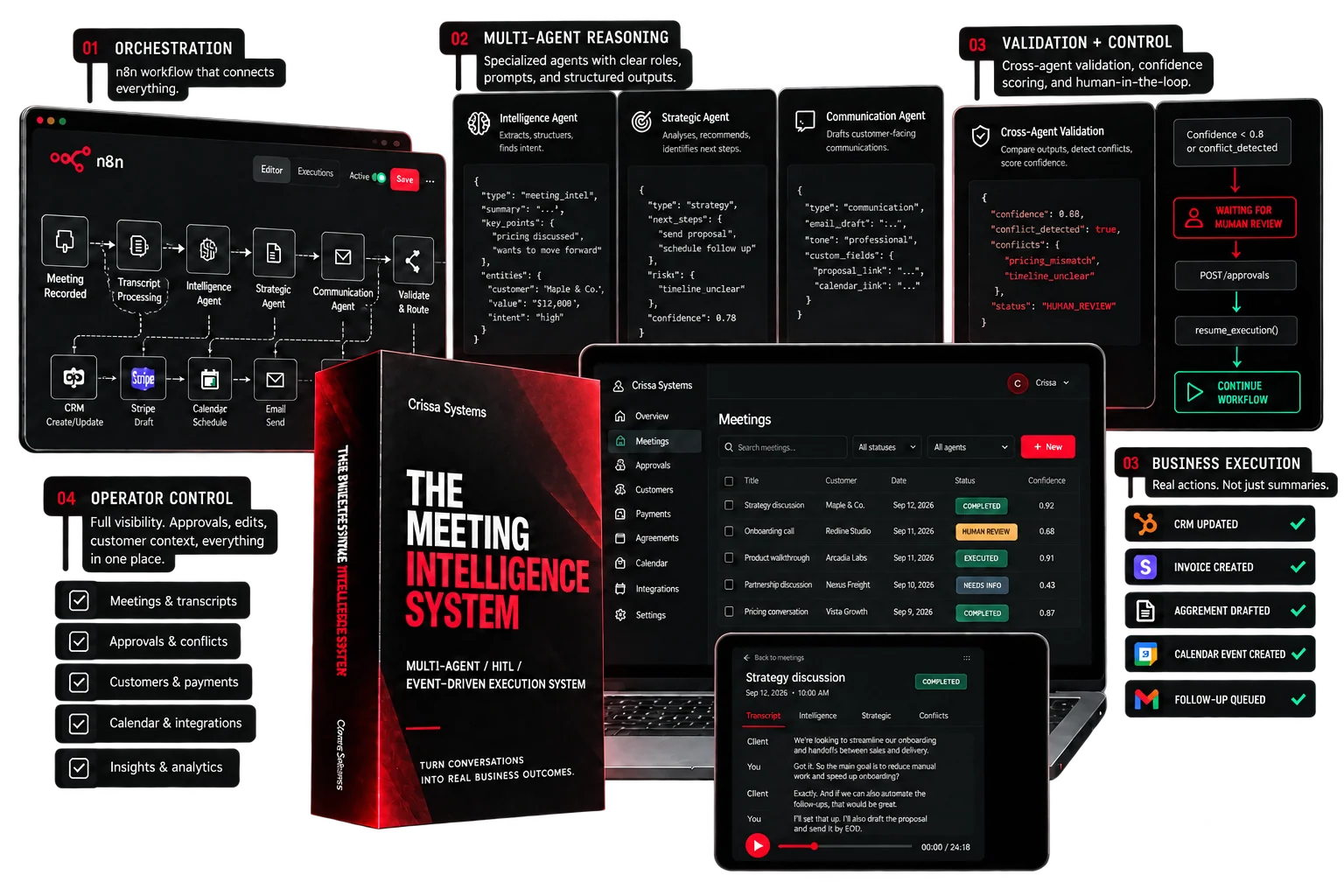
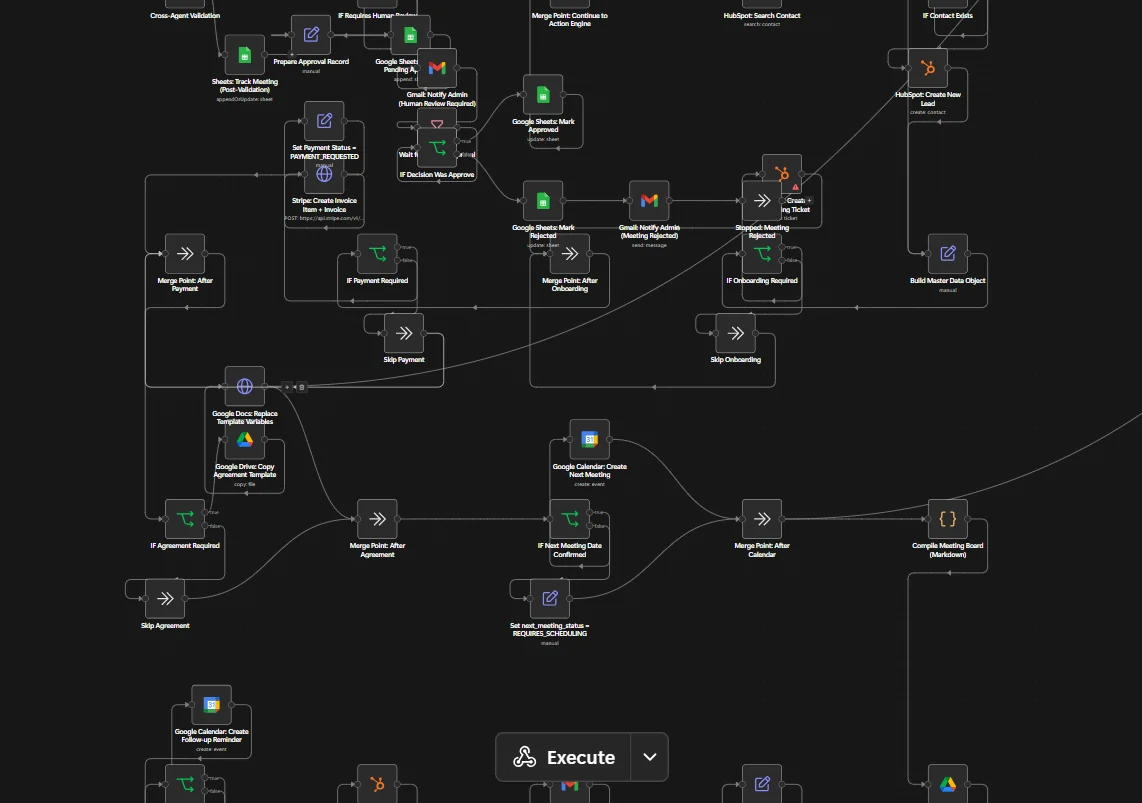
THE ACTUAL N8N WORKFLOWThe system captures the resume URL, writes the pending decision to the approval queue, suspends execution, and waits for a human decision. Approve it and the workflow resumes from exactly where it stopped. Reject it and nothing downstream fires. Human-in-the-loop isn't a Slack message asking someone to check something. The human is literally part of the execution path.
Here's another rule I gave the system: the model is never the source of truth for business state. It can reason about reality. It doesn't get to redefine reality. If the model and the system of record disagree, the database wins. every time.
TRANSCRIPTwhat was said
STRIPEpayment state
E-SIGN PROVIDERsignature state
Source of truth lives outside the LLM.
HUBSPOTcustomer state
GOOGLE CALENDARscheduled state
SYSTEM OF RECORD(real data)→AI REASONING(under constraints)→ACTION(when safe)
LLM ≠ DATABASE×No.
SOMETIMES THE RIGHT ANSWER IS “I DON'T KNOW.”
One of the most useful things I taught this system was when NOT to fill in the blanks. Missing information is a state to handle, not an invitation to hallucinate.
GENERIC AGENT
Client: “Let's schedule another call next week.”
▣Tuesday, 2:00 PM ✓cute. absolutely not.OUR SYSTEM
Client: “Let's schedule another call next week.”
◎REQUIRES_SCHEDULING
Reason:
Date/time was not explicitly confirmed.
Action:
Create scheduling task.
Refusing to guess is a feature.
SO I BUILT MYSELF A CONTROL ROOM.
Once workflows can pause, resume, request approval, create business actions, and update multiple systems... I need to see what the hell they're doing.
✦psst... this one actually worksclick APPROVE AND CONTINUE
Operator Panel overview · meeting detail · HUMAN_REVIEW state · completed execution after approval/resume
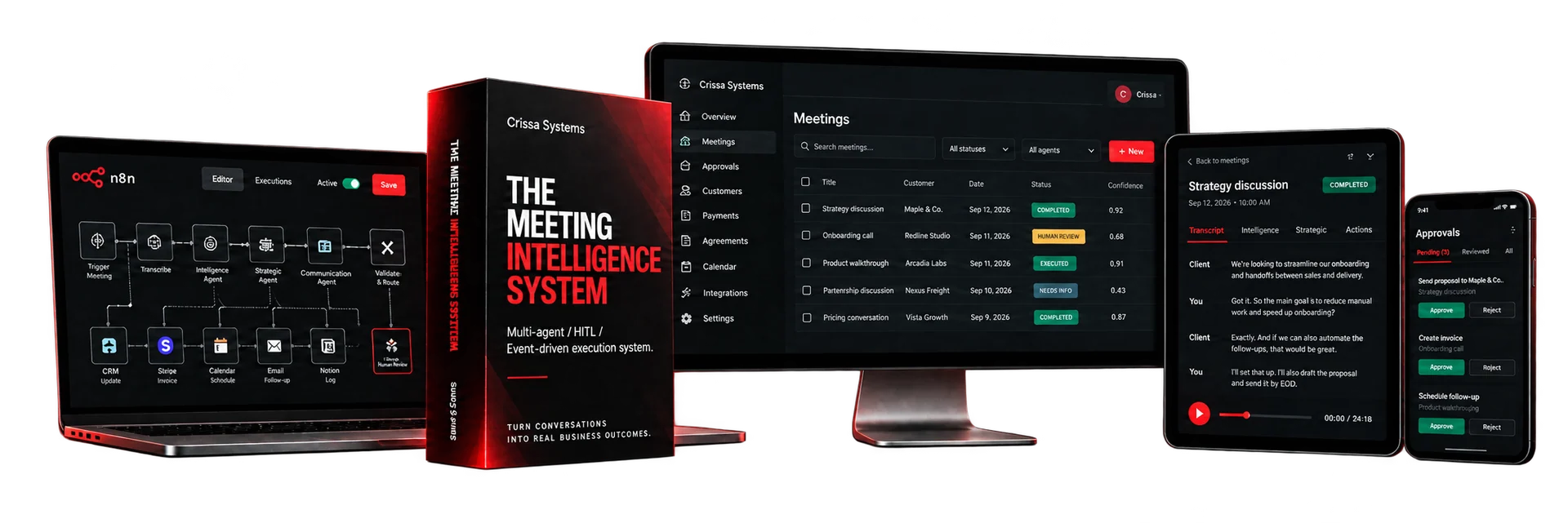
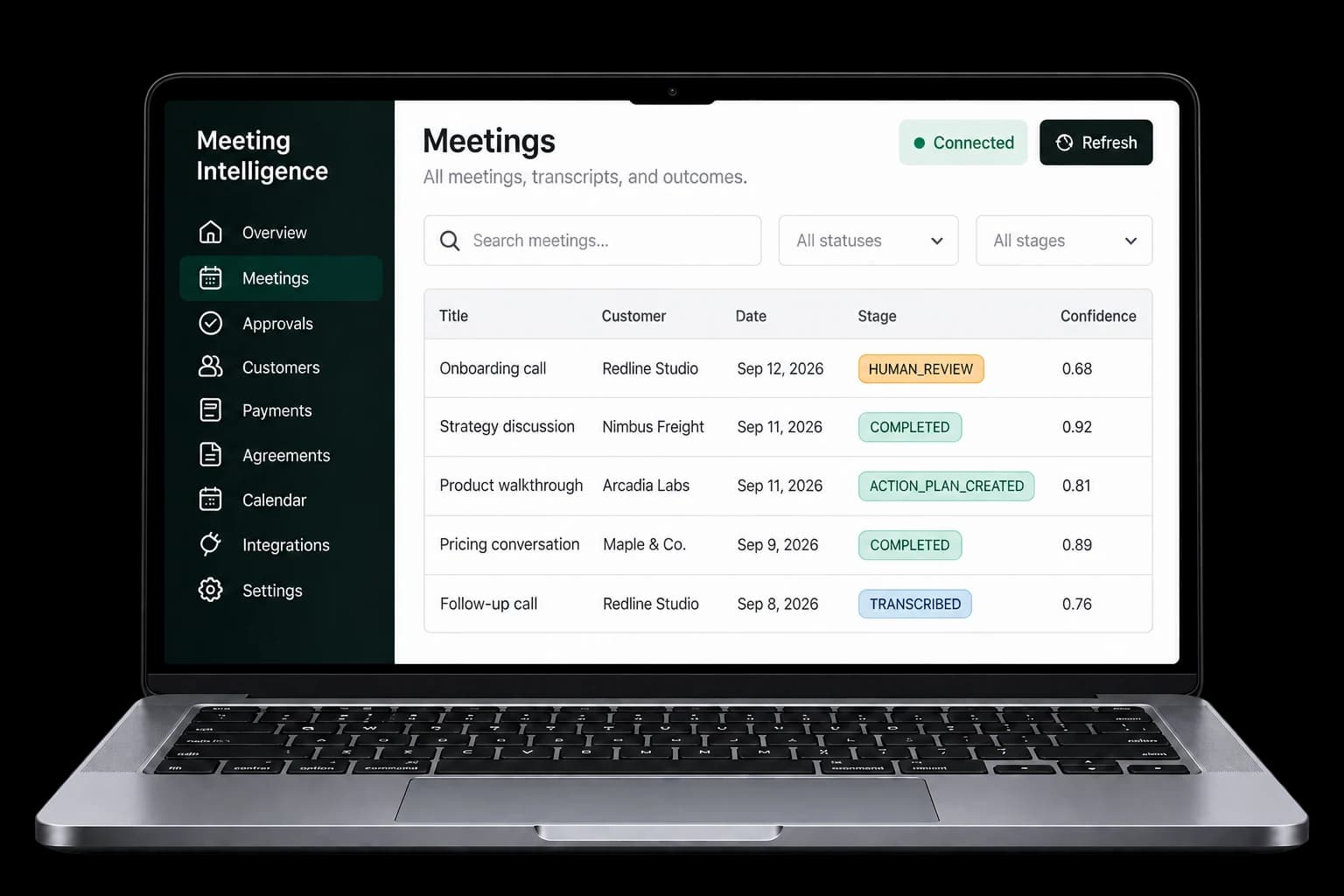
So I built an Operator Panel where I can inspect meetings, transcripts, agent outputs, confidence, conflicts, approvals, customers, payments, agreements, calendar state, and integrations. Because “the automation probably handled it” is not an observability strategy. If the system can act, I want a place where I can see why it acted.
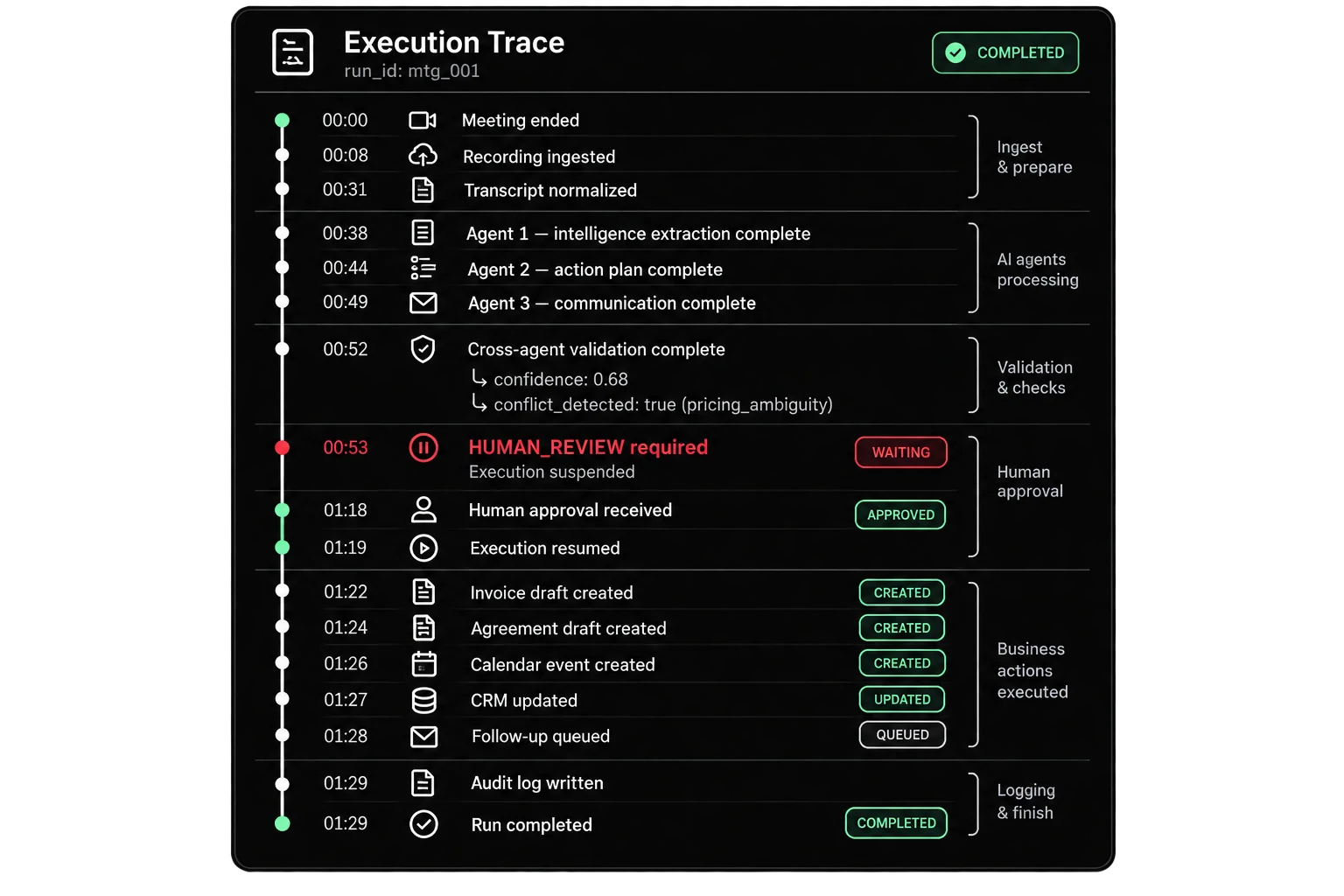
Fair question. Architecture diagrams are cute. Show me the execution. One meeting moves through ingestion → reasoning → validation → human review → resumed execution → business actions → completion. Every meaningful state change is written into the execution trail. One meeting. One trace. Every decision accounted for.
SO WHAT'S ACTUALLY UNDER THE HOOD?
By this point, the workflow itself is only one piece of the system. The product isn't the workflow. It's the architecture around the workflow.
INGESTIONRecordings + transcript
REASONINGMulti-agent LLM pipeline
VALIDATIONCross-agent consistency
CONTROLHuman-in-the-loop wait/resume
ORCHESTRATIONn8n
EXECUTIONCRM / Payments / Agreements / Calendar
OBSERVABILITYOperator panel + audit trail
n8n moves things around. The agents reason. Validation checks them. The control layer decides whether execution is allowed. Business systems stay authoritative. The Operator Panel keeps the whole thing visible.
zoomCall recordings
◉OpenAILLMs
HubSpotCRM
stripePayments
Google WorkspaceSheets, Calendar, Drive, Gmail
n8nAutomation
〆E-signmentsE-signments
THE HARDEST PART WASN'T THE AI.
Getting an LLM to generate something wasn't difficult. Deciding when I should trust it enough to act was.
Reason when reasoning is useful.Execute when execution is safe.Stop when confidence isn't enough.Ask for judgment when judgment actually matters. That's the difference between AI that gives you an answer and AI that's allowed to operate inside a business.
I DIDN'T REMOVE THE HUMAN. I MADE IT PICKIER. I don't need a human approving every invoice, follow-up, CRM update, and calendar action. I need the human when there's ambiguity, conflict, missing information, or an action that genuinely requires judgment. Automate the obvious. Escalate the uncertain. Keep the human for the expensive decisions.
♧Ambiguity
▧Conflicting outputs
⌁Missing information
▤High-impact actions
✎Human judgment when it matters
basically a very over-engineered way of saying:
THE CALL ENDS. THE BUSINESS KEEPS MOVING.
Less post-call admin. Fewer missed follow-ups. Structured business state. Clear ownership. Human attention only when it's actually required.
The meeting shouldn't create another hour of admin. It should create the next state of the business.
BUSINESS ACTIONSDownstream work keeps moving.
Agreements drafted
Invoices prepared
CRM updated
Calendar scheduled
Follow-ups created
WORKFLOW COMPLETEDMeeting processed successfully.
Transcript analyzed
Customer record updated
Invoice drafted
Agreement prepared
Calendar event created
Follow-up email queued
THE OFFER
and if you're thinking...
“COOL. NOW I HAVE TO BUILD ALL OF THAT?”
lol. no.
I PACKAGED THE WHOLE FUCKING SYSTEM.
Not a course about how to build it.
Not a folder of prompts.
Not an n8n screenshot you're supposed to reverse engineer.
The actual build.
WHAT YOU GET
YOU GET THE WHOLE BUILD.
01
THE BRAIN
The reasoning layer.
Agent prompts & schemas
Structured outputs
Cross-agent validation
Confidence scoring
Conflict detection & human-review routing
02
THE NERVOUS SYSTEM
The orchestration layer.
Intake → agents → validation
Wait/resume execution
Approvals
Downstream execution
Audit logging
IMPORT IT. DON'T REBUILD IT FROM A SCREENSHOT.03
THE CONTROL ROOM
The Operator Panel.
Meetings, transcripts, intelligence
Strategic plans, conflicts, approvals
Customers, payments, agreements
Calendar & integrations
Threshold configuration
YES, YOU GET THE DASHBOARD TOO.04
THE GUARDRAILS
The part that stops the AI from getting creative with your business.
Confidence thresholds
Human approval gates
Deterministic sources of truth
Missing-info handling
Conflict detection & audit trails
Pause/resume logic
BORING IS A FEATURE WHEN AI CAN TOUCH YOUR BUSINESS.05
THE “PLEASE DON'T MAKE ME FIGURE THIS OUT” KIT
Get it running
Step-by-step setup guide
Environment/config checklist
Integration instructions
Prompt architecture & schemas
Customization guide
Testing & troubleshooting
because handing you 83 n8n nodes and saying “good luck babe” would be insane.
ONE PURCHASE. THE ENTIRE SYSTEM. NO CRISSA SYSTEMS SUBSCRIPTION.
You own the build. Customize it. Extend it. Use it for your business.
Third-party services and API usage may have their own costs.
THE CHOICE
YOU HAVE TWO OPTIONS.
OPTION A
BUILD EVERYTHING YOURSELF.
Start from zero
Learn the tools
Design the architecture
Write the prompts
Build the approval layer
Connect everything
Test it
Break it
Fix it
character development ✨
OR
OPTION B
START WITH THE SYSTEM I ALREADY BUILT.
Everything you just saw, already built for you to import, customize, and make your own.
 TRANSCRIPT
 STRIPE
 E-SIGN PROVIDER
 HUBSPOT
 GOOGLE CALENDAR
 HubSpot
 n8n